
Rate Hike Today?
Today would be the perfect time for Kevin Warsh to do something almost nobody expects: raise interest rates.

Today would be the perfect time for Kevin Warsh to do something almost nobody expects: raise interest rates.
Not because the Fed intends to embark on some Volcker-esque tightening campaign over the long term. In fact, it can’t. Not because I think rates are headed materially higher over the next year. And certainly not because I believe the U.S. economy could actually withstand a prolonged period of restrictive monetary policy. It can’t.
That’s precisely what makes the idea so interesting to me. The Fed has painted itself into a corner over the last decade and a half. The global financial system has become so dependent on cheap money, leverage, government deficits, and asset inflation that everyone understands sustained higher rates would definitely break something important. The Treasury market would feel it. Corporate credit would feel it. Commercial real estate would feel it. Equities would feel it. Before long, policymakers would almost certainly be forced to ride to the rescue once again.
I don’t think many serious observers believe otherwise.
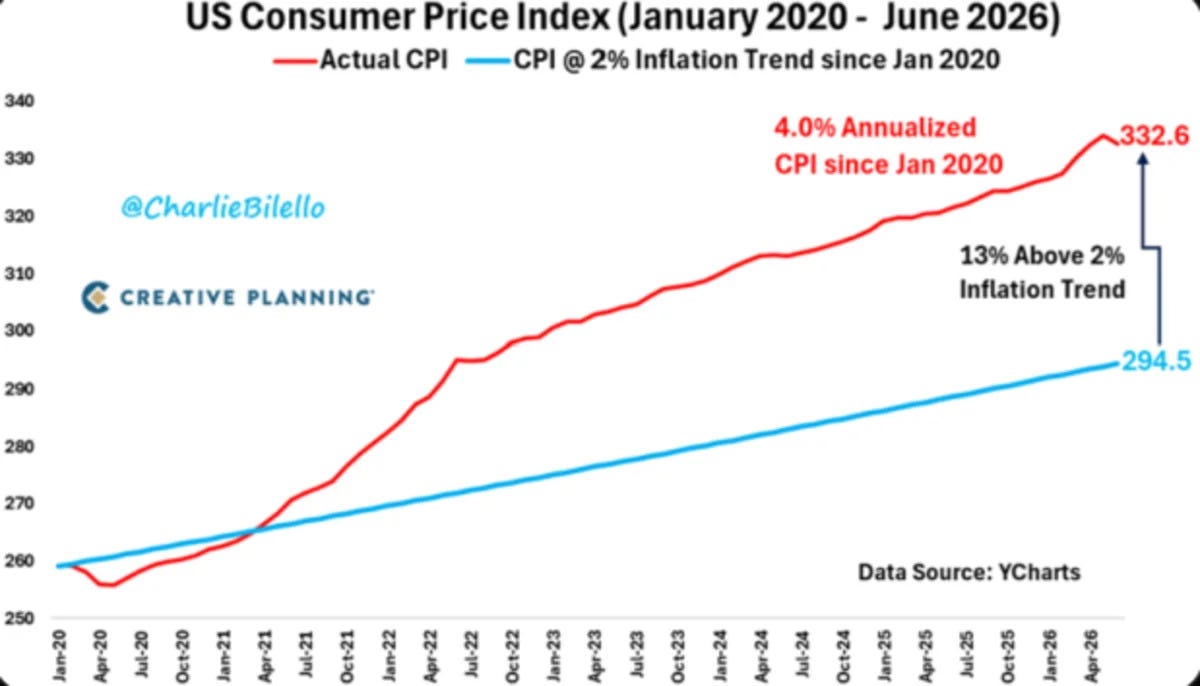
But that’s exactly why a single, symbolic rate hike today…as an arrival gesture by Kevin Warsh…could be such a fascinating move. Inflation remains far above the Fed’s long-term target. Yes, recent data has shown some welcome moderation, and that gives Warsh political cover not to hike. But taken as a whole, inflation is still elevated enough that a quarter-point increase could easily be justified on the merits. If the Fed truly wants to convince markets that inflation fighting still matters, actions speak louder than carefully worded press conferences.
For years, investors have been conditioned to believe that the Fed’s first priority is protecting asset prices. Every dip becomes a buying opportunity because everyone assumes monetary policy will eventually ride to the rescue. Whether that perception is entirely fair is almost beside the point. Markets believe it.
A surprise rate hike would immediately challenge that assumption for the first time since I can remember. Would it permanently change market psychology? Probably not. But it would introduce something markets haven’t had in a very long time: uncertainty about whether the Fed is willing to tolerate pain.
And that uncertainty has value. Warsh has repeatedly suggested he wants to distinguish himself from his predecessor. Warsh used his first comments as Federal Reserve chair to signal a return to a more disciplined, less predictable central bank.
He stressed that restoring price stability and maintaining credibility on inflation would be the Fed’s top priorities, made clear that future rate decisions would be driven by incoming economic data rather than preannounced guidance, emphasized the Fed’s independence from political pressure, and intentionally refused to signal the path of future interest rates.
The message seemed to be straightforward: markets should stop relying on the Fed to telegraph every move and instead focus on the underlying strength of the economy and the trajectory of inflation.
Look, every Fed chair talks about credibility, independence, and restoring confidence in the institution. Today offers an opportunity to demonstrate that those aren’t just talking points.
Raise rates.
Not because you’re planning another five hikes. Not because you’re trying to engineer a recession. Raise them because you’re simply reminding markets that the Federal Reserve is supposed to care about the purchasing power of the dollar before it cares about next week’s S&P 500 performance.
Then, watch what happens. Maybe markets absorb it better than expected. If they do, perhaps there is even room for another hike down the road. Maybe they don’t. Maybe stocks sell off sharply, credit spreads widen, and volatility returns with a vengeance. If that’s the outcome, then you’ve learned something valuable, too.
You’ve stress-tested financial conditions and the already-too-coddled psychology of the markets without committing yourself to an endless tightening cycle.
Let’s not pretend the Fed would never reverse course if things became disorderly. History suggests otherwise. If financial markets seized up or Treasury markets stopped functioning properly, I have little doubt policymakers would intervene. They always have. In my view, it’s entirely possible various forms of liquidity support already play a larger role behind the scenes than most investors appreciate.
That’s exactly why a symbolic hike becomes even more intriguing.
If the Fed ultimately retains the ability, and willingness, to step in during periods of genuine financial stress, why not spend some of that credibility today reminding everyone that inflation still matters?
The irony is that markets already assume the Fed will eventually blink. A single rate hike doesn’t eliminate that expectation. But it does force investors to reconsider the timing, the threshold, and the willingness of policymakers to tolerate discomfort before stepping back in. That alone changes behavior.
Would one hike solve America’s inflation problem? Of course not. Would it magically restore fiscal discipline? Not a chance. Would it erase years of monetary excess? Impossible. But it would send a message that has been missing from monetary policy for years: the Federal Reserve is at least willing to make markets uncomfortable in pursuit of its stated mandate.
Even if only for one meeting. Even if everyone knows it probably won’t last forever. Sometimes the most important move isn’t the one that changes policy for years. It’s the one that changes expectations today. And Kevin Warsh has that opportunity…

QTR’s Disclaimer: Please read my full legal disclaimer on my About page here. This post represents my opinions only. In addition, please understand I am an idiot and often get things wrong and lose money. I may own or transact in any names mentioned in this piece at any time without warning. Contributor posts and aggregated posts have been hand selected by me, have not been fact checked and are the opinions of their authors. They are either submitted to QTR by their author, reprinted under a Creative Commons license with my best effort to uphold what the license asks, or with the permission of the author. I cannot guarantee the accuracy of all facts and figures included in this article though I made my best effort to get them right. I have been wrong before and will be wrong again, and encourage you to always double check, do your own research and speak to a licensed financial professional.
This is not a recommendation to buy or sell any stocks or securities, just my opinions. I often lose money on positions I trade/invest in. I may add any name mentioned in this article and sell any name mentioned in this piece at any time, without further warning. None of this is a solicitation to buy or sell securities. I may or may not own names I write about and are watching. Sometimes I’m bullish without owning things, sometimes I’m bearish and do own things. Just assume my positions could be exactly the opposite of what you think they are just in case. If I’m long I could quickly be short and vice versa. I won’t update my positions.
As of May 20, 2026 I am attempting to no longer actively trade (read my story here). My investing/saving is mostly done by recurring contributions mostly to sector ETFs and a few select equities, trusted third parties who oversee my accounts, and advisors. Such advisors or funds, through individual equities, options, index funds, mutual funds, ETFs, or other securities, may have positions in, exposure to, or holdings of names mentioned herein that I know nothing about. Basically, via index funds, ETFs and individual equities it is possible I could own, have exposure to, or not own anything at any point. As of the same date, May 20, 2026, in an attempt to lead a healthier lifestyle, I’ve also excluded myself from fantasy sports, sports betting, online and in-person casinos and prediction markets.
And all positions can change immediately as soon as I publish this, with or without notice and at any point I can be long, short or neutral on any position. You are on your own. Do not make decisions based on my blog. I exist on the fringe. If you see numbers and calculations of any sort, assume they are wrong and double check them. I failed Algebra in 8th grade and topped off my high school math accolades by getting a D- in remedial Calculus my senior year, before becoming an English major in college so I could bullshit my way through things easier.
The publisher does not guarantee the accuracy or completeness of the information provided in this page. These are not the opinions of any of my employers, partners, or associates. I did my best to be honest about my disclosures but can’t guarantee I am right; I write these posts after a couple beers sometimes. I edit after my posts are published because I’m impatient and lazy, so if you see a typo, check back in a half hour. Also, I just straight up get shit wrong a lot. I mention it twice because it’s that important.
It is a close call. My bet is they won't hike rates today. Warsh has the task forces going on and launching a rate hike cycle before it, would kill the point of the task forces. He can say that the last CPI reading was OK, no sign of inflation spillover from higher commodity prices, long-term inflation expectations are stable and until the latter is true, higher oil prices reduces disposable income through higher fuel prices and of course he can use the war is a temporarily thing.
But again, it is a close call. The long-term bond yields are ugly, but it is mostly a term premium problem, not much the Fed can do here.
Ive been enjoying your past couple of interviews. Fell asleep listening to you and Andy last night. His testimony reaffirmed my silver and gold concerns as I am long and heavy there.
I still laugh when I listen to commentators and financial analysts cry about "high" rates. My first used car loan...17% my first mortgage....7% and I was ecstatic about that mortgage rate.
My guess is UNC today. 🍿
🍻 to another day above ground.